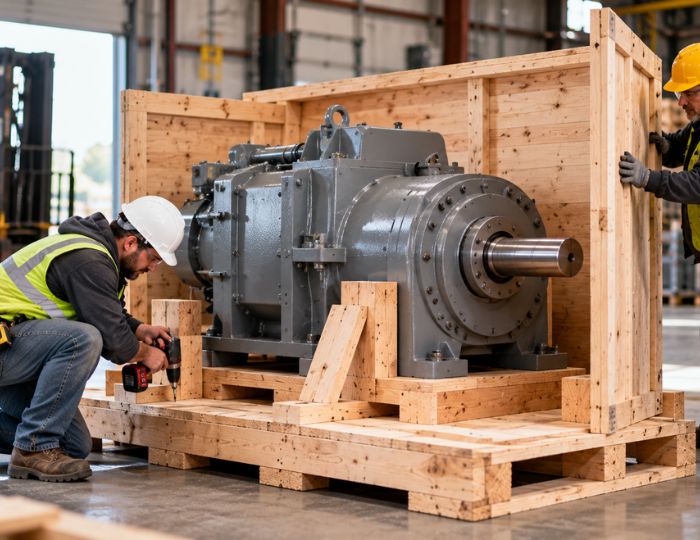
Shipping a small, boxed product is one thing. Shipping a large machine, industrial component, or piece of heavy equipment is something entirely different.
Heavy products may have irregular dimensions, concentrated weight, sensitive components, or specific lifting and handling requirements. They may travel hundreds or thousands of miles and pass through multiple loading and unloading points before reaching their destination.
The packaging has to be designed accordingly.
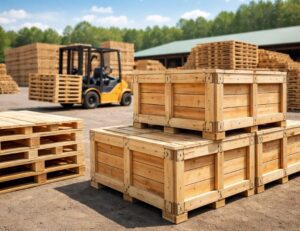
For these applications, custom wood crates can provide a packaging solution built around the size, weight, handling requirements, and transportation needs of the product.
At Trumbull Forest Products, we understand that industrial wood packaging isn’t simply about putting boards around a product. The entire packaging system needs to work with the load.
Why Heavy Equipment Often Requires Custom Packaging
Machinery doesn’t usually conform to convenient packaging dimensions.
Industrial equipment may include protruding components, uneven weight distribution, delicate controls, heavy bases, motors, piping, or other features that affect how the product needs to be supported.
Trying to adapt a large or unusually shaped product to generic packaging can create unnecessary complications.
Custom packaging reverses that approach.
Instead of making the product fit the packaging, the packaging is designed around the product.
Our broader pallet and crate capabilities allow businesses to select packaging based on actual transportation and handling requirements.
Start With Accurate Dimensions and Weight
A custom crate design begins with accurate information about the product.
Length, width, and height matter, but so does weight.
The packaging needs to support the product during storage, lifting, transportation, and handling.
Weight distribution is particularly important.
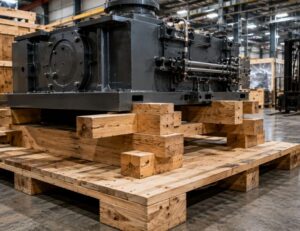
A machine weighing several thousand pounds may not distribute that weight evenly across its base. Motors, frames, tanks, or other components can create concentrated loads that require additional structural support.
The base of the crate must be designed with those forces in mind.
Account for More Than the Machine’s Outer Dimensions
The physical dimensions of the equipment aren’t always the same as the dimensions required for safe packaging.
Additional clearance may be necessary for blocking, cushioning, dunnage, or internal supports.
Businesses should also account for removable components, protrusions, lifting points, and anything else that changes how the equipment fits inside the crate.
Accurate information at the beginning can make the packaging design process much more effective.
The Base Is a Critical Part of the Crate
When people picture a crate, they often focus on the walls.
For heavy machinery, the base can be one of the most important components.
It supports the load and interacts directly with forklifts, lifting equipment, and transportation surfaces.
Depending on the application, a custom base may function similarly to a heavy-duty wood skid.
The design needs to account for load placement and material handling.
Our article about custom wood skids for industrial applications provides additional insight into why purpose-built support platforms are valuable for demanding loads.
Blocking Helps Keep Machinery Where It Belongs
Heavy equipment shouldn’t be able to move freely inside its packaging.
Transportation involves acceleration, braking, turns, vibration, loading, unloading, and other forces.
Blocking can help secure equipment to its base and limit unwanted movement.
The exact configuration depends on the product.
Industrial blocking may be placed around structural points or other suitable areas to help stabilize the load.
Trumbull Forest Products has covered these applications in our guide to industrial blocking solutions.
The goal is to design the packaging so the equipment and crate work together as a stable system.
Dunnage Adds Support Where It’s Needed
Dunnage can serve several purposes within industrial packaging.
It may separate components, fill space, provide support, distribute loads, or help protect products during transportation.
Trumbull Forest Products supplies hardwood dunnage for industrial applications.
Our article on dunnage in industrial shipping and packaging explains how these materials can become an important part of the complete packaging system.
For heavy machinery, dunnage requirements should be evaluated alongside the crate structure and blocking rather than added as an afterthought.
Consider How the Crate Will Be Handled
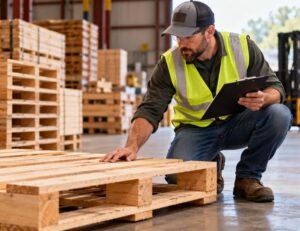
Packaging design needs to account for the people and equipment that will move it.
Will a forklift handle the crate? From which direction? Will overhead lifting be involved? Will the crate move through a warehouse before shipment? How will the recipient unload it?
These questions should be considered before the crate is built.
A design that protects the product but makes handling unnecessarily difficult can create problems elsewhere in the supply chain.
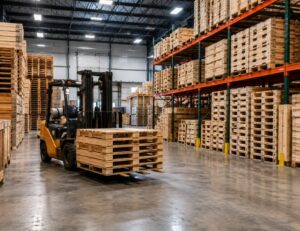
The same principle applies to pallets. As our article about pallet design and forklift efficiency explains, packaging and material handling equipment need to work together.
Domestic and International Shipping Have Different Considerations
Destination matters.
Equipment shipped domestically may have different packaging requirements from equipment being exported internationally.
When wood packaging is used in international shipping, heat-treatment requirements may apply.
Trumbull Forest Products offers heat-treated wood packaging solutions for applicable export requirements.
We’ve also explained the role of heat-treated pallets in international shipping for businesses that need additional background on the process.
If machinery will cross international borders, packaging requirements should be addressed early rather than immediately before shipment.
Custom Crating Can Help Protect Valuable Products
Industrial equipment can represent a substantial investment.
Damage during transportation can result in more than a repair bill.
It may cause installation delays, production interruptions, missed deadlines, replacement costs, additional freight charges, or dissatisfied customers.
Proper packaging helps reduce avoidable transportation risk.
That’s one reason Trumbull Forest Products emphasizes custom wood packaging for product protection.
The packaging should be viewed as part of the shipping strategy—not simply another expense added at the end.
Choose Packaging Based on the Entire Journey
Before selecting a crate design, map out what happens to the equipment from the moment it’s packaged until the recipient removes it.
Consider:
- Product dimensions and weight
- Weight distribution
- Forklift access
- Lifting requirements
- Internal blocking
- Dunnage
- Storage
- Transportation method
- Number of handling points
- Domestic or international destination
- Unloading requirements
Those details help determine how the packaging should be constructed.
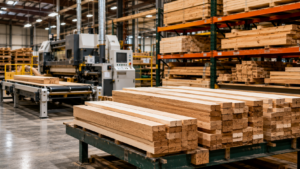
Trumbull Forest Products manufactures custom wood packaging for demanding industrial applications using lumber and components selected for the job.
If you’re preparing machinery or heavy equipment for shipment, contact Trumbull Forest Products to discuss your packaging requirements.
Key Takeaways
- Heavy machinery often requires packaging designed around the specific product.
- Dimensions, total weight, and weight distribution all affect crate construction.
- The crate base is critical because it supports the equipment and interacts with material handling systems.
- Blocking can help limit unwanted movement during transportation.
- Dunnage can provide separation, support, load distribution, and stabilization.
- Forklift access and other handling requirements should be incorporated into the design.
- International shipments may introduce heat-treatment requirements for wood packaging.
- Custom crating can help reduce transportation risks for valuable industrial products.
- Packaging should be designed around the product’s entire journey from origin to destination.