A pallet may look like a relatively simple component of your shipping operation, but choosing the wrong one can create problems throughout the supply chain.
Product dimensions, weight distribution, handling equipment, storage conditions, transportation methods, and final destination can all affect which pallet design makes sense.
That’s why selecting a pallet shouldn’t begin with the question, “What standard pallet can we buy?”
A better question is, “What does this pallet actually need to do?”
At Trumbull Forest Products, we manufacture wood pallets and other industrial wood packaging solutions for businesses with a wide range of material handling and shipping requirements. Understanding the application allows us to develop a solution around the product rather than forcing the product onto an unsuitable platform.
Start With the Size and Shape of Your Product
Product dimensions are one of the first factors to evaluate.
The pallet needs to provide an appropriate platform for the load without creating unnecessary overhang or wasting material and transportation space.
Standard-sized pallets can work well for many applications, but not every product fits neatly within standard dimensions.
Large equipment, unusually shaped components, long products, and specialized industrial materials may require a different approach.
That’s where custom pallets become particularly useful. A pallet can be designed around the dimensions of the product, material handling requirements, and intended shipping environment.
Custom sizing can also help businesses make better use of available warehouse, trailer, and shipping space.
Consider the Weight—and How That Weight Is Distributed
Knowing the total product weight is important, but it doesn’t tell the whole story.
How the weight sits on the pallet matters too.
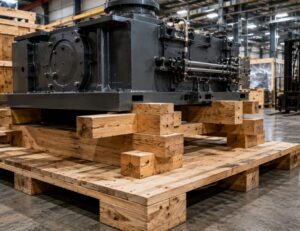
A uniformly distributed load creates different structural demands than a piece of equipment that concentrates most of its weight on a few small contact points.
That distinction can influence deck board placement, stringer or block configuration, lumber dimensions, fasteners, and the overall pallet design.
Our guide to wood pallet load capacity and design factors explores why there isn’t one universal weight capacity that applies to every wooden pallet.
Don’t Choose a Pallet Based on Weight Alone
Two products weighing the same amount may require completely different pallets.
One might be a group of uniformly stacked boxes. The other could be a machine with several heavy contact points.
Their total weights may match, but the forces applied to the pallet do not.
That’s why product configuration should be considered alongside total load weight.
Think About How Forklifts Will Handle the Load
A pallet doesn’t just support a product while it sits still.
It also needs to function within the material handling system.
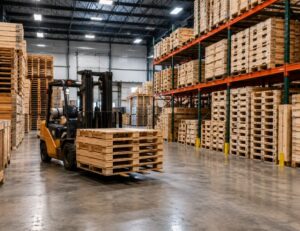
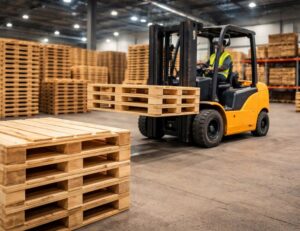
Forklift entry, pallet jack access, warehouse layout, loading procedures, and the direction from which a pallet needs to be approached can all affect pallet design.
Poor alignment between pallet design and handling equipment can make routine movements less efficient.
Trumbull Forest Products has covered this relationship in our guide to how pallet design impacts forklift efficiency.
When developing a custom pallet, businesses should think about the entire journey—from the production floor to storage, loading, transportation, unloading, and final use.
Evaluate the Shipping Environment
Where is the product going?
A pallet used for short-distance domestic transportation may have different requirements than one moving through a more complicated distribution network.
Consider how many times the load will be handled, whether it will be stored, how it will be secured during transportation, and what environmental conditions it may encounter.
International shipments introduce another important consideration: wood packaging requirements.
Trumbull Forest Products provides heat-treated pallets for applications where compliant wood packaging is required.
Our article explaining how heat treatment prepares pallets for exports provides additional information for businesses planning international shipments.
Decide Whether You Need a Pallet, Skid, or Crate
Sometimes the right solution isn’t actually a pallet.
Depending on the product and application, a wood skid or custom wood crate may make more sense.
Pallets are commonly used when loads need to be moved repeatedly with forklifts or pallet jacks. Skids can provide a sturdy base for certain equipment and industrial applications. Crates can add another level of enclosure and protection around valuable or sensitive products.
We’ve compared these options in our guide to choosing custom pallets, skids, or crates.
The best choice depends on how the product needs to be supported, moved, stored, and protected.
Consider Blocking and Dunnage Requirements
The platform underneath the product is only part of the packaging system.
Some shipments need additional materials to help stabilize, separate, support, or secure the load.
Hardwood dunnage can play an important role in industrial packaging applications where loads need additional support.
Our guide explaining what dunnage is and why it matters provides a deeper look at how these materials are used.
Blocking may also be incorporated into a packaging design to help prevent equipment or products from shifting.
Instead of viewing the pallet as an isolated component, businesses should consider how the complete packaging system works together.
Look Beyond the Lowest Initial Price
Cost matters in every manufacturing and shipping operation.
But the least expensive pallet isn’t automatically the lowest-cost solution.
A poorly matched pallet can contribute to product damage, inefficient handling, wasted trailer space, workflow problems, or the need to replace packaging more frequently.
Custom design can help address these issues by aligning the packaging with the application.
Businesses should evaluate value across the entire shipping process rather than comparing pallets only by unit price.
Trumbull Forest Products also offers inventory management services that can help businesses manage recurring wood product requirements more efficiently.
Work With a Supplier That Understands the Application
Selecting the right pallet requires information.
A supplier should understand what you’re shipping, how much it weighs, how the weight is distributed, how the load will be handled, where it’s going, and whether additional packaging components are required.
Trumbull Forest Products manufactures pallets, crates, and wood packaging solutions for industrial and commercial applications.
We also produce custom-cut lumber that supports a range of manufacturing and packaging requirements.
If your current pallet isn’t performing the way you need it to—or you’re developing packaging for a new product—contact Trumbull Forest Products to discuss your specifications.
Key Takeaways
- Pallet selection should begin with the product and application rather than a standard size.
- Product dimensions and weight distribution both affect pallet design.
- Two loads with identical total weights may require different pallet configurations.
- Forklift and pallet jack requirements should be considered during the design process.
- Shipping distance, handling frequency, storage, and destination can influence pallet requirements.
- International shipments may require heat-treated wood packaging.
- Some products may be better suited to skids or crates than traditional pallets.
- Dunnage and blocking can provide additional support and stabilization.
- Businesses should consider total shipping and handling efficiency rather than pallet price alone.